

What Marriage Taught Me About Healing
Growing up, I was blessed to be raised in a loving family by educated and hardworking parents who valued education, responsibility, and perseverance. They worked hard to give us opportunities, and many of the values they taught me still guide me today.
At the same time, like many people, I experienced childhood challenges that shaped how I saw myself, relationships, and the world around me. Some left emotional wounds and patterns of thinking that I did not fully understand until adulthood.
We may leave our childhood homes physically, but we often carry their lessons, fears, expectations, and survival patterns into our relationships. Research supports this. A longitudinal study found that the quality of family relationships during adolescence remained connected to romantic attachment and relationship behaviour at ages 25 and 27. It also found that later romantic relationships could influence attachment security, showing that childhood shapes us but does not have to determine our future (Dinero et al., 2008).
I find that deeply hopeful. Our past may explain our patterns, but healing gives us the opportunity to change them.
We Do Not Enter Marriage With a Blank Slate
When I entered marriage, I began to understand that none of us starts with a blank slate. We bring what we learned about love, conflict, affection, responsibility, forgiveness, and communication. We bring our strengths and hopes, but also our fears, expectations, insecurities, and ways of protecting ourselves.
Marriage became a place where I experienced love, but it also revealed areas within me that needed healing, growth, and intentional change. Close relationships bring hidden patterns to the surface. They show us whether we withdraw, become defensive, try to control situations, or struggle to express what we truly need.
These patterns can become deeply established. Gottman and Levenson found that couples’ conflict patterns showed approximately 80% stability over three years. Without intentional change, couples may repeat the same arguments, reactions, and emotional patterns for years (Gottman Institute, n.d.-a).
I eventually learned that being married is not the same as truly knowing one another. A wedding begins a marriage, but emotional intimacy is built through curiosity, friendship, trust, vulnerability, and daily attention.
Love Alone Is Not Enough
Love matters, but healthy marriages are not sustained by love alone. They require friendship, trust, emotional safety, commitment, and daily intentional choices.
Two people can love one another deeply and still struggle to communicate, manage conflict, repair hurt, or stay emotionally connected. My personal and professional journey led me to the Gottman approach, a research-based model developed through the work of Drs. John and Julie Gottman.
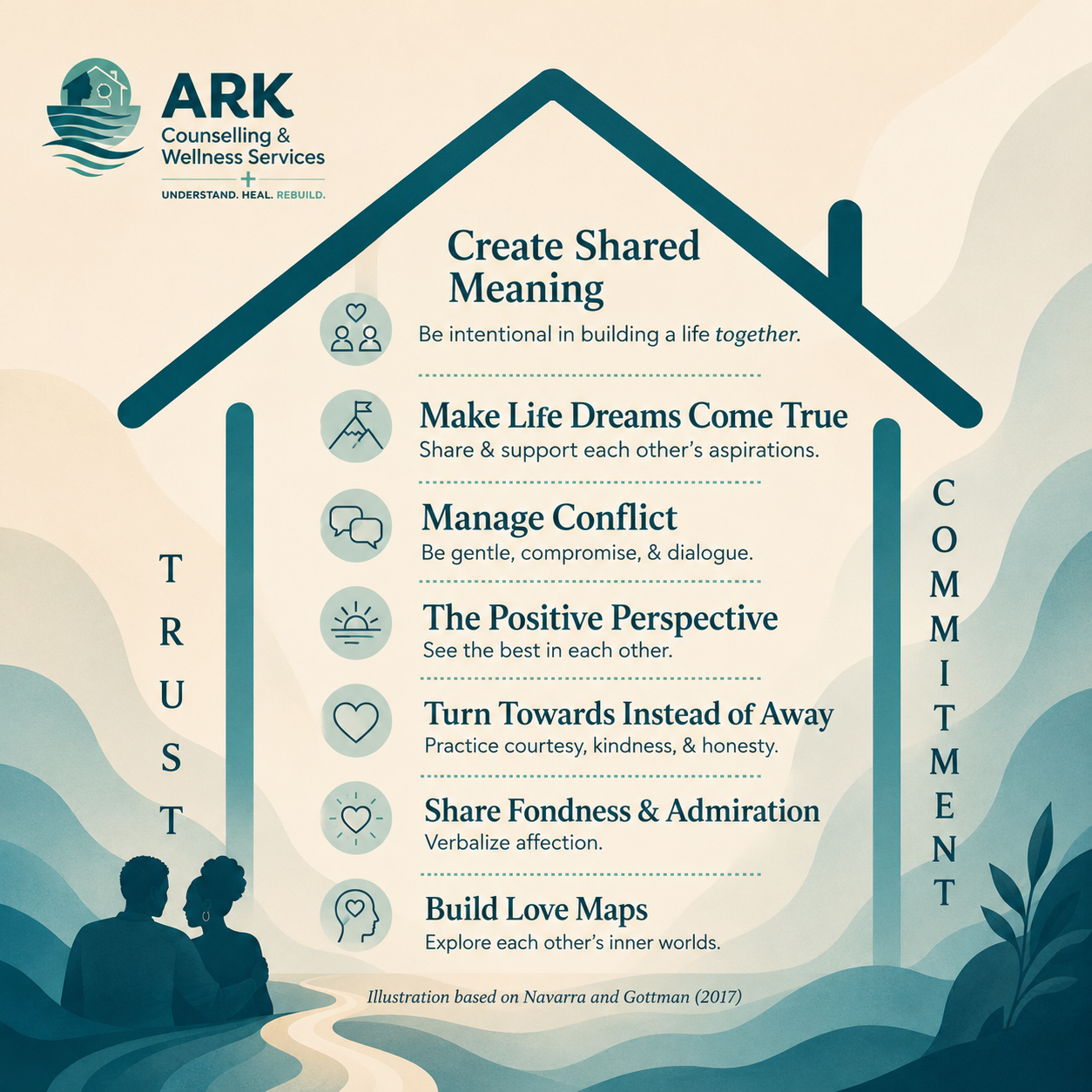
The Sound Relationship House illustrates the different layers that support a healthy relationship, including friendship, trust, commitment, conflict management, and shared meaning.
The approach does not define a successful marriage as one without conflict. Conflict is inevitable when two different people build a life together. What matters is how couples handle differences, remain connected, and repair the relationship after hurt.
Gottman and Levenson found that approximately 69% of relationship problems are perpetual. These recurring differences may be rooted in personality, values, habits, preferences, or lifestyle needs and may never disappear completely (Gottman Institute, n.d.-a).
At first, this may sound discouraging. I find it freeing. Healthy couples are not those who solve every disagreement. They learn to handle ongoing differences with respect, empathy, humour, and flexibility.
Friendship Is the Foundation
One of the most powerful lessons I learned from the Gottman approach is that friendship forms the foundation of a strong marriage. Couples need more than children, bills, routines, and shared responsibilities. They need to remain interested in each other as people.
The Gottmans use the term love maps to describe how well someone knows their partner’s inner world, including their dreams, fears, joys, pressures, aspirations, and current concerns. Building love maps means continuing to ask: What is worrying my partner? What are they looking forward to? What pressures are they carrying? What makes them feel appreciated? What has changed in their inner world?
People continue to grow throughout life. We may know who our spouse was five years ago but fail to notice who they are becoming today. Healthy couples remain curious.
Gottman’s observations showed how actively connected couples maintain this friendship. During a ten-minute dinner interaction, stable couples made as many as 100 bids for connection, while distressed couples made around 65 (Gottman Institute, 2019).
This does not mean couples should count every question or smile. It shows that healthier relationships contain more attention, interest, and engagement. Friendship stays alive when partners continue reaching for one another.
Fondness and Admiration Matter
Over time, couples can begin noticing weaknesses more than strengths. Daily frustrations may slowly replace appreciation, and partners may focus mainly on what is missing.
Healthy couples intentionally express what they value in one another. This may mean thanking a spouse for something small, recognising their effort, affirming their character, or showing affection without waiting for a special occasion.
Gottman and Levenson found that stable couples maintained approximately five positive interactions for every negative interaction during conflict. Outside conflict, the balance was closer to 20 positive interactions for every negative one (Gottman Institute, 2017).
Positive interactions include listening, validating, expressing gratitude, showing affection, using appropriate humour, and making an effort to understand. This does not mean healthy marriages contain no negativity. It means difficult moments exist within a much larger atmosphere of goodwill. Appreciation helps protect a marriage from resentment and contempt.
Turning Towards Each Other
Throughout the day, partners make small attempts to connect. A bid may be a smile, a question, a story, a touch, a request for help, or a quiet search for comfort.
A spouse may say, “I had a difficult day,” point something out, ask for an opinion, or sit closer. The other person can turn towards that bid, turn away, or turn against it. Turning towards may be as simple as putting down the phone, making eye contact, asking a follow-up question, offering reassurance, or listening fully.
Gottman’s research found a striking difference between couples who stayed married and those who later divorced. At a six-year follow-up, couples who remained married had turned towards one another’s bids approximately 86% of the time. Couples who divorced had done so only about 33% of the time (Gottman Institute, 2019).
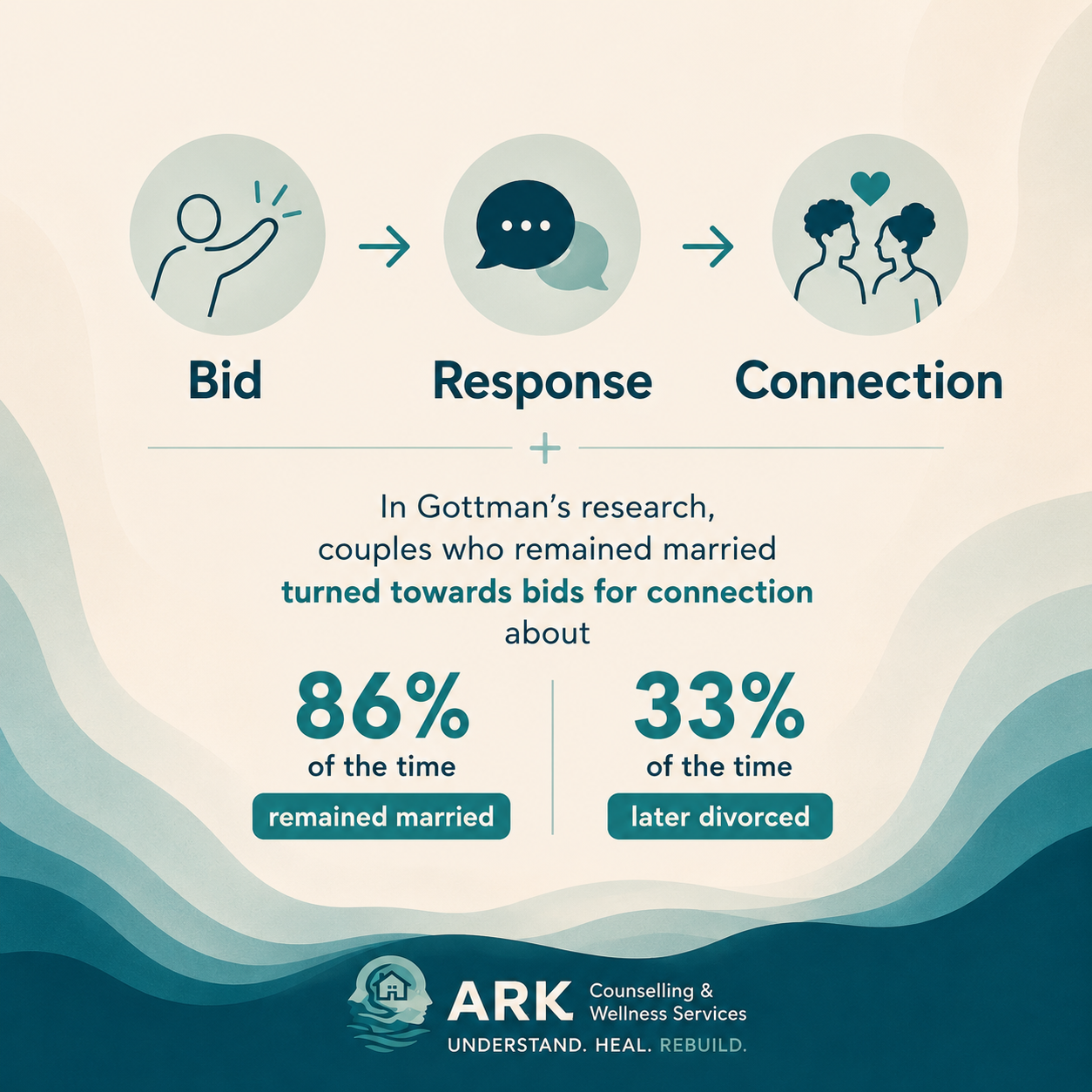
In Gottman’s research, couples who remained married turned towards bids for connection about 86% of the time, compared with 33% among couples who later divorced.
This finding has always stood out to me. Marriages are not strengthened only through large gestures. They are strengthened when one person reaches out and the other responds. These small moments build trust, closeness, and emotional intimacy over time.
Trust and Commitment Are Built Daily
Trust is not created only through major promises. It grows through repeated experiences of honesty, reliability, emotional availability, and consideration. A partner learns to trust when they consistently experience messages such as: You will tell me the truth. You will consider how your choices affect me. You will listen when something matters. You will not use my vulnerability against me. You will remain present during difficult seasons.
Commitment is also more than remaining legally married. It is the daily decision to protect the relationship and continue choosing one another. It means addressing problems rather than quietly building distance and treating the relationship as something worth nurturing and repairing.
Across seven longitudinal studies, Gottman’s research programme reported predicting marital outcomes with an average accuracy of more than 90% by examining several factors together, including conflict behaviour, emotional expression, physiological responses, positive and negative interactions, and how couples described their relationship history (Gottman Institute, n.d.-a).
This does not mean one argument can predict whether a marriage will end. It shows that repeated patterns of speaking, responding, withdrawing, and repairing reveal a great deal about the health of a relationship.
Conflict Does Not Have to Destroy a Marriage
Disagreement is inevitable. The important question is whether couples know how to disagree without destroying emotional safety.
The Gottman approach emphasises repair attempts, words or actions that interrupt negativity and help partners reconnect. These may include:
“I am sorry.”
“I became defensive.”
“I understand why that hurt you.”
“Can we start again?”
“Let us pause and return to this when we are calmer.”
Repair may also involve appropriate humour, affection, taking responsibility, softening one’s tone, or listening more openly.
Sometimes repair requires allowing the body to calm down. In one Gottman intervention study, couples took a 20-minute break during conflict while their heart rates moved closer to normal. When they resumed, their conversations improved, and they had greater access to humour and affection (Gottman Institute, n.d.-b).
A break should not become abandonment or punishment. There must be a clear commitment to return to the conversation. Healthy couples still become angry, defensive, overwhelmed, or distant. The difference is that they learn how to return, take responsibility, and repair the bond. Repair does not mean pretending nothing happened. It means refusing to allow one painful moment to define the relationship.
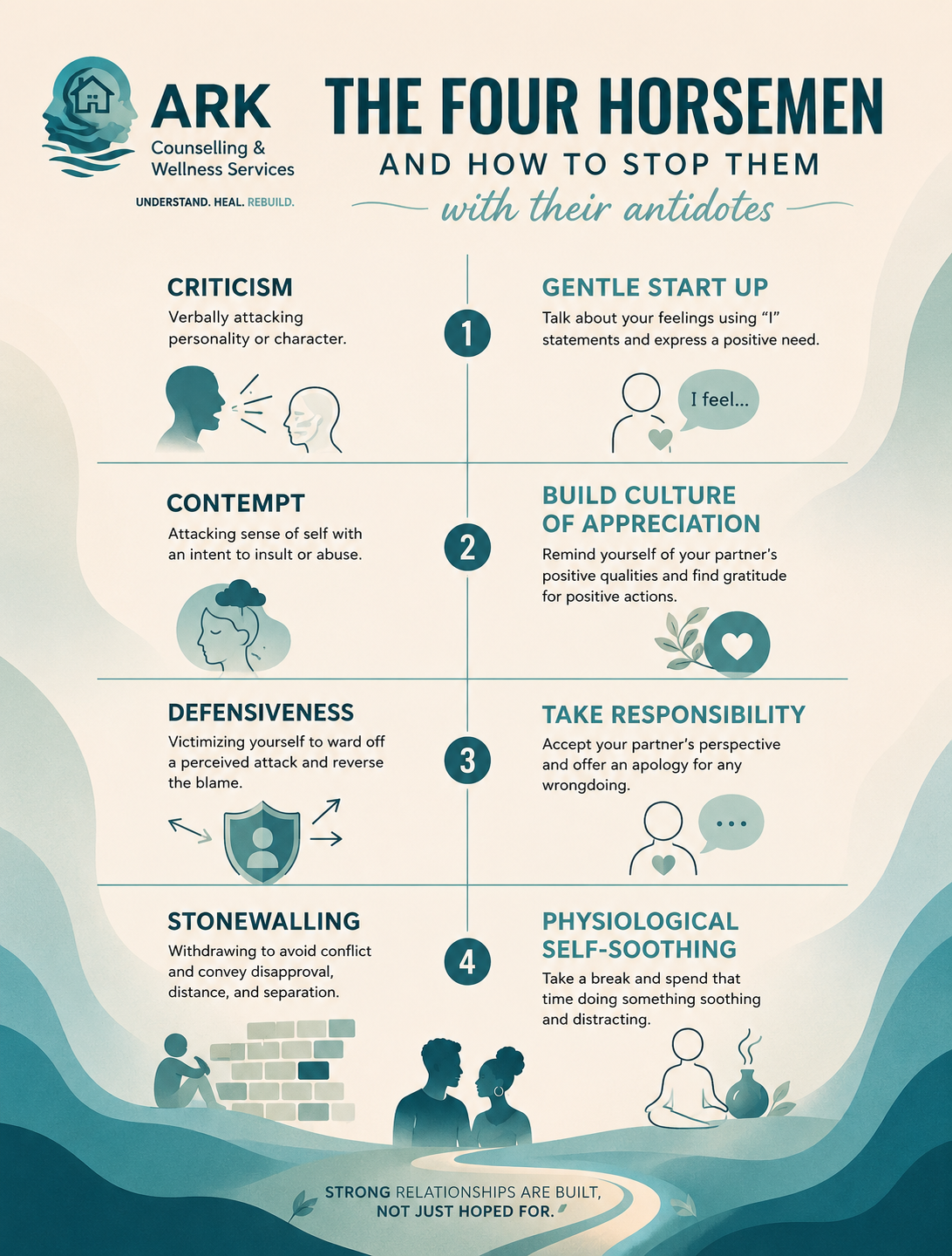
The Gottman approach identifies four destructive conflict patterns and pairs each one with a healthier alternative.
Creating Emotional Safety
Emotional safety allows love to deepen. Couples need to know they can express their thoughts, fears, needs, and vulnerabilities without being mocked, dismissed, threatened, or treated with contempt.
When emotional safety is missing, people begin protecting themselves. They may hide their struggles, withdraw affection, or avoid difficult conversations. Silence may create temporary peace, but it also creates distance.
Couples can also carry different beliefs about emotion. One partner may have learned that feelings should be discussed, while another learned that emotions should be hidden or quickly controlled.
Gottman’s research found that differences in how couples understood and responded to emotion, known as meta-emotion, predicted marital stability or divorce with approximately 80% accuracy in the sample studied (Gottman, 2017). Emotional safety is therefore not only about allowing someone to speak. It also involves learning to understand and respond to their emotional world.
Building Shared Meaning
Healthy marriages create shared meaning through common values, traditions, goals, rituals, faith, family practices, and a shared vision for life.
Couples need to ask not only, “How will we manage our home?” but also: What kind of home are we creating? What values will guide our family? What do we want our children to learn from our relationship? What are we building together?
Shared meaning gives marriage purpose beyond daily responsibilities. It also changes how couples approach conflict. If 69% of relationship problems are perpetual, the goal cannot always be to remove every difference. Sometimes the deeper task is to understand the dreams, fears, and values beneath the disagreement (Gottman Institute, n.d.-a).
Marriage as a Place of Healing
As both a wife and a counsellor who works with couples, I have found these principles invaluable.
I encourage couples to build love maps, express appreciation, remain curious, respond to bids for connection, develop repair skills, cultivate trust, create emotional safety, and intentionally build shared meaning.
These are not simply counselling techniques. They are everyday practices found in the way we greet each other, listen, apologise, show gratitude, handle conflict, offer comfort, and make time for connection.
The research gives weight to these simple practices. Turning towards bids 86% rather than 33% of the time, maintaining approximately five positive interactions for every negative one during conflict, and learning to manage the 69% of problems that may remain perpetual show that strong marriages are built through repeated patterns, not isolated moments (Gottman Institute, 2017, 2019, n.d.-a).
The finding that conflict patterns can remain approximately 80% stable over three years also reminds us that time alone does not heal every relationship. Couples must intentionally change the patterns that repeatedly cause pain (Gottman Institute, n.d.-a).
Looking back, I can see that my childhood shaped me, but it did not have to define me. I could appreciate the good I received while still recognising the wounds and patterns that needed healing. Healing did not require me to reject my past. It required me to understand it honestly and decide what I wanted to carry forward.
My marriage has become a place of love, learning, healing, and growth. The Gottman approach has given me both a professional framework for helping couples and a personal roadmap for nurturing my own relationship.
A healthier marriage is not built in one dramatic moment. It is built gradually through friendship, trust, curiosity, appreciation, repair, emotional safety, and the daily decision to keep choosing one another. Our childhood may explain where some of our patterns began, but healing allows us to decide where those patterns will end.
References
Dinero, R. E., Conger, R. D., Shaver, P. R., Widaman, K. F., & Larsen-Rife, D. (2008). Influence of family of origin and adult romantic partners on romantic attachment security. Journal of Family Psychology, 22(4), 622–632.https://doi.org/10.1037/0893-3200.22.3.622
Gottman, J. M. (2017). The natural principles of love. Journal of Family Theory & Review, 9(1), 7–26.https://doi.org/10.1111/jftr.12182
Gottman, J. M., & Levenson, R. W. (2000). The timing of divorce: Predicting when a couple will divorce over a 14-year period. Journal of Marriage and Family, 62(3), 737–745.https://doi.org/10.1111/j.1741-3737.2000.00737.x
Gottman, J. M., & Levenson, R. W. (2002). A two-factor model for predicting when a couple will divorce: Exploratory analyses using 14-year longitudinal data. Family Process, 41(1), 83–96.https://doi.org/10.1111/j.1545-5300.2002.40102000083.x
Gottman, J. M., & Silver, N. (2015). The seven principles for making marriage work: A practical guide from the country’s foremost relationship expert. Harmony Books.
Gottman Institute. (2017, October 4). The magic relationship ratio, according to science.https://www.gottman.com/blog/the-magic-relationship-ratio-according-science/
Gottman Institute. (2019, February 11). Improve your relationship by paying attention to “bids”.https://www.gottman.com/blog/want-to-improve-your-relationship-start-paying-more-attention-to-bids/
Gottman Institute. (n.d.-a). Marriage and couples research.https://www.gottman.com/about/research/couples/
Gottman Institute. (n.d.-b). The empirical basis for Gottman Method Couples Therapy.https://www.gottman.com/blog/the-empirical-basis-for-gottman-method-couples-therapy/
